

Sensory evaluation was conducted in the Sakeology Basic Practice of the master’s program in the Graduate School Sakeology Program for FY2026
The graduate students worked on sake brewing in the laboratory in the Sakeology Basic Practice, a part of the curriculum of the master’s program in the Graduate School Sakeology Program (*1) for FY2026.
This year, eleven students (six from the Humanities and Social Sciences Program and five from the Sciences and Technologies Program) conducted sake brewing.
They brewed their own sake using yeast cultured themselves while monitoring fermentation for 20 days, and conducted various experiments related to sake brewing such as analyzing rice grains and measuring enzyme activity of rice koji.
At the end of the practice, they conducted a sensory evaluation (*2) of sake. After learning the method of sensory evaluation and the characteristic aroma of sake using samples of the aroma components contained in sake, the students evaluated three types of sake, including one sake they brewed themselves and two control sake, and compared the results with the analytical values.
The student commented that their understanding of the difficulties of sake brewing and of flavor and aroma components had deepened. One student remarked, “Even in an era when aroma and taste can be quantified as data, I was able to appreciate the significance of sensory evaluation, which directly assesses differences in human perception.”
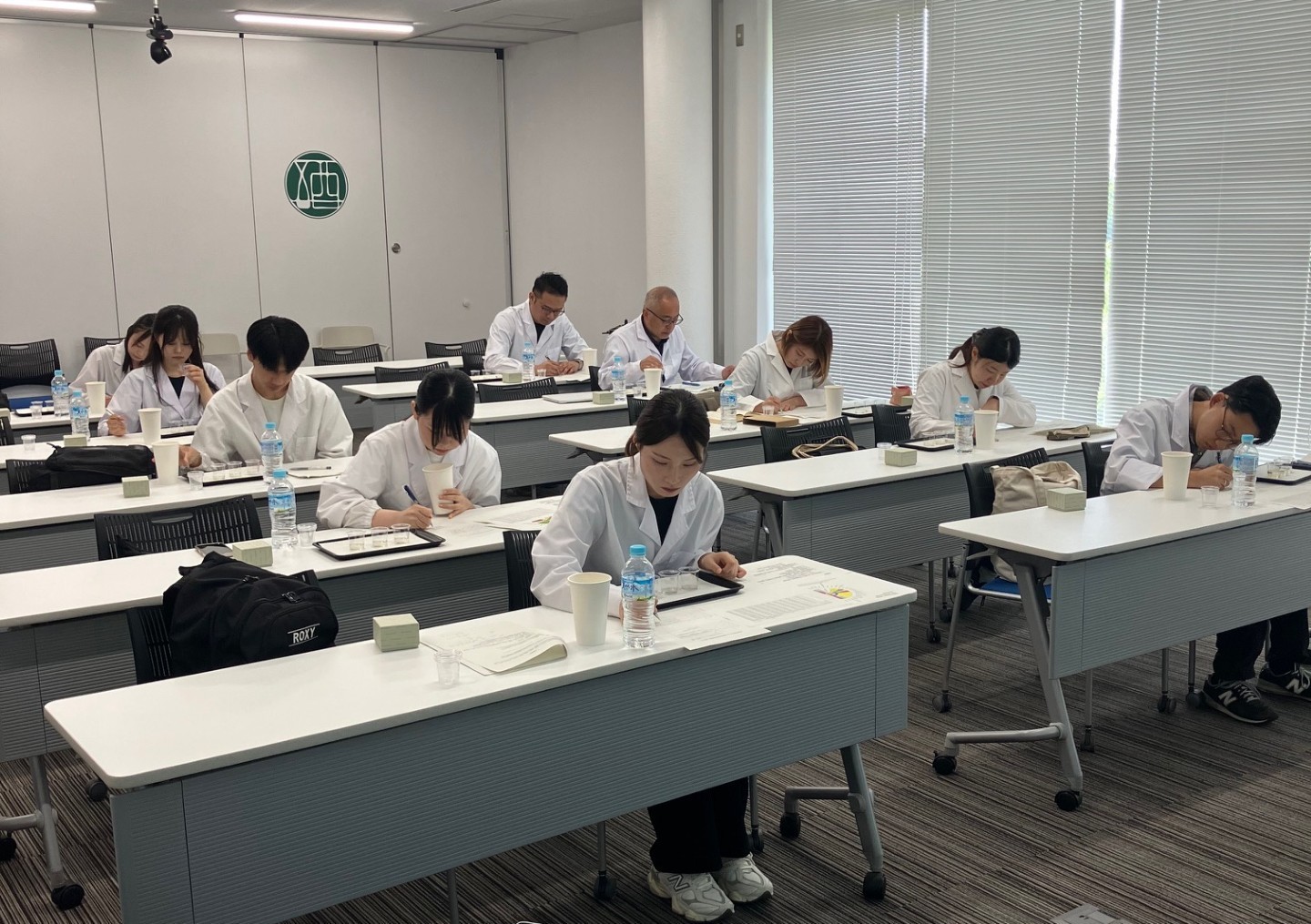
Sensory evaluation process
The sensory evaluation was broadcast on NHK (Japan Broadcasting Corporation) news program and in The Yomiuri Shimbun. The news reports and article can be accessed through the links below.
・NHK Niigata: “Niigata University Graduate Students Taste Sake They Brewed Themselves”
https://news.web.nhk/newsweb/na/nb-1030037188
・The Yomiuri Shimbun: “Graduate Students Experience Tasting the Sake They Brewed Themselves at Niigata University”
https://www.yomiuri.co.jp/local/niigata/news/20260721-GYTNT00160/
(*1) Niigata University commenced the master’s program in the Graduate School Sakeology Program in April 2022 and the doctoral program in April 2023. In April 2026, the master’s programs of the Graduate School of Modern Society and Culture and the Graduate School of Science and Technology were integrated into the master’s program of the Graduate School of Integrated Arts and Sciences.
These programs conduct education and research that integrates specialized domains in the humanities and sciences with a focus on the subject of sake, adopting content that provides a bird’s-eye view of diverse fields, ranging from raw materials and production to the sale and consumption of sake as well as culture, history, tradition, and health, in addition to the areas of specialization of the students.
Please click below for details.
The website of the Graduate School of Integrated Arts and Sciences
Sakeology Program | Education Programs | Graduate School of Integrated Arts and Sciences, Niigata University
(*2) Sensory evaluation is a scientific discipline used to assess the color, aroma, and taste of sake through human senses such as visual, olfactory, and gustatory perception. Sensory evaluation of sake is also known as sake tasting, or Kikizake.